MoreExam
1. Question Content...
EXPLANATION
Answer: X - EXPLANATION Content.
Question1: You need to immediately change the storage class of an existing Google Cloud bucket. You need to reduce service cost for infrequently accessed files stored in that bucket and for all files that will be added to that bucket in the future. What should you do?
Question2: You are designing an application that uses WebSockets and HTTP sessions that are not distributed across the web servers. You want to ensure the application runs properly on Google Cloud Platform. What should you do?
Question3: You are setting up a Windows VM on Compute Engine and want to make sure you can log in to the VM via RDP. What should you do?
Question4: You have sensitive data stored in three Cloud Storage buckets and have enabled data access logging. You want to verify activities for a particular user for these buckets, using the fewest possible steps. You need to verify the addition of metadata labels and which files have been viewed from those buckets. What should you do?
Question5: You need to manage multiple Google Cloud Platform (GCP) projects in the fewest steps possible. You want to configure the Google Cloud SDK command line interface (CLI) so that you can easily manage multiple GCP projects. What should you?
Question6: You are running a data warehouse on BigQuery. A partner company is offering a recommendation engine based on the data in your data warehouse. The partner company is also running their application on Google Cloud. They manage the resources in their own project, but they need access to the BigQuery dataset in your project. You want to provide the partner company with access to the dataset What should you do?
Question7: You want to host your video encoding software on Compute Engine. Your user base is growing rapidly, and users need to be able 3 to encode their videos at any time without interruption or CPU limitations. You must ensure that your encoding solution is highly available, and you want to follow Google-recommended practices to automate operations. What should you do?
Question8: You created an instance of SQL Server 2017 on Compute Engine to test features in the new version. You want to connect to this instance using the fewest number of steps. What should you do?
Question9: You have been asked to migrate a docker application from datacenter to cloud. Your solution architect has suggested uploading docker images to GCR in one project and running an application in a GKE cluster in a separate project. You want to store images in the project img-278322 and run the application in the project prod-278986. You want to tag the image as acme_track_n_trace:v1. You want to follow Google-recommended practices. What should you do?
Question10: You have 32 GB of data in a single file that you need to upload to a Nearline Storage bucket. The WAN connection you are using is rated at 1 Gbps, and you are the only one on the connection. You want to use as much of the rated 1 Gbps as possible to transfer the file rapidly. How should you upload the file?
Question11: You need to track and verity modifications to a set of Google Compute Engine instances in your Google Cloud project. In particular, you want to verify OS system patching events on your virtual machines (VMs). What should you do?
Question12: You want to configure 10 Compute Engine instances for availability when maintenance occurs. Your requirements state that these instances should attempt to automatically restart if they crash. Also, the instances should be highly available including during system maintenance. What should you do?
Question13: You are running multiple microservices in a Kubernetes Engine cluster. One microservice is rendering images. The microservice responsible for the image rendering requires a large amount of CPU time compared to the memory it requires. The other microservices are workloads that are optimized for n1-standard machine types. You need to optimize your cluster so that all workloads are using resources as efficiently as possible. What should you do?
Question14: Your company requires that Google Cloud products are created with a specific configuration to comply with your company's security policies You need to implement a mechanism that will allow software engineers at your company to deploy and update Google Cloud products in a preconfigured and approved manner. What should you do?
Question15: You are building an application that processes data files uploaded from thousands of suppliers. Your primary goals for the application are data security and the expiration of aged dat a. You need to design the application to:* Restrict access so that suppliers can access only their own data.* Give suppliers write access to data only for 30 minutes.* Delete data that is over 45 days old.You have a very short development cycle, and you need to make sure that the application requires minimal maintenance. Which two strategies should you use? (Choose two.)
Question16: An employee was terminated, but their access to Google Cloud Platform (GCP) was not removed until 2 weeks later. You need to find out this employee accessed any sensitive customer information after their termination. What should you do?
Question17: You are creating an application that will run on Google Kubernetes Engine. You have identified MongoDB as the most suitable database system for your application and want to deploy a managed MongoDB environment that provides a support SLA. What should you do?
Question18: Your organization uses Active Directory (AD) to manage user identities. Each user uses this identity for federated access to various on-premises systems. Your security team has adopted a policy that requires users to log into Google Cloud with their AD identity instead of their own login. You want to follow the Google-recommended practices to implement this policy. What should you do?
Question19: You are using multiple configurations for gcloud. You want to review the configured Kubernetes Engine cluster of an inactive configuration using the fewest possible steps. What should you do?
Question20: A team of data scientists infrequently needs to use a Google Kubernetes Engine (GKE) cluster that you manage. They require GPUs for some long-running, non-restartable jobs. You want to minimize cost. What should you do?
Question21: You are developing a financial trading application that will be used globally. Data is stored and queried using a relational structure, and clients from all over the world should get the exact identical state of the dat a. The application will be deployed in multiple regions to provide the lowest latency to end users. You need to select a storage option for the application data while minimizing latency. What should you do?
Question22: You have a virtual machine that is currently configured with 2 vCPUs and 4 GB of memory. It is running out of memory. You want to upgrade the virtual machine to have 8 GB of memory. What should you do?
Question23: Your customer has implemented a solution that uses Cloud Spanner and notices some read latency-related performance issues on one table. This table is accessed only by their users using a primary key. The table schema is shown below.You want to resolve the issue. What should you do?
Question24: You are given a project with a single virtual private cloud (VPC) and a single subnetwork in the us-central1 region. There is a Compute Engine instance hosting an application in this subnetwork. You need to deploy a new instance in the same project in the europe-west1 region. This new instance needs access to the application. You want to follow Google-recommended practices. What should you do?
Question25: Your company completed the acquisition of a startup and is now merging the IT systems of both companies. The startup had a production Google Cloud project in their organization. You need to move this project into your organization and ensure that the project is billed lo your organization. You want to accomplish this task with minimal effort. What should you do?
Question26: You are working with a user to set up an application in a new VPC behind a firewall. The user is concerned about data egress. You want to configure the fewest open egress ports. What should you do?
Question27: You have created a new project in Google Cloud through the gcloud command line interface (CLI) and linked a billing account. You need to create a new Compute Engine instance using the CLI. You need to perform the prerequisite steps. What should you do?
Question28: You need to deploy an application in Google Cloud using savorless technology. You want to test a new version of the application with a small percentage of production traffic. What should you do?
Question29: Your company has a Google Cloud Platform project that uses BigQuery for data warehousing. Your data science team changes frequently and has few members. You need to allow members of this team to perform queries. You want to follow Google-recommended practices. What should you do?
Question30: You created a cluster.YAML file containingresources:name: clustertype: container.v1.clusterproperties:zone: europe-west1-bcluster:description: My GCP ACE clusterinitialNodeCount: 2You want to use Cloud Deployment Manager to create this cluster in GKE. What should you do?
Question31: You have a Google Cloud Platform account with access to both production and development projects. You need to create an automated process to list all compute instances in development and production projects on a daily basis. What should you do?
Question32: You are deploying an application to a Compute Engine VM in a managed instance group. The application must be running at all times, but only a single instance of the VM should run per GCP project. How should you configure the instance group?
Question33: You deployed a new application inside your Google Kubernetes Engine cluster using the YAML file specified below.You check the status of the deployed pods and notice that one of them is still in PENDING status:You want to find out why the pod is stuck in pending status. What should you do?
Question34: You want to configure a solution for archiving data in a Cloud Storage bucket. The solution must be cost-effective. Data with multiple versions should be archived after 30 days. Previous versions are accessed once a month for reporting. This archive data is also occasionally updated at month-end. What should you do?
Question35: You are configuring Cloud DNS. You want !to create DNS records to point home.mydomain.com, mydomain.com. and www.mydomain.com to the IP address of your Google Cloud load balancer. What should you do?
Question36: You are deploying a production application on Compute Engine. You want to prevent anyone from accidentally destroying the instance by clicking the wrong button. What should you do?
Question37: Your company has a large quantity of unstructured data in different file formats. You want to perform ETL transformations on the dat a. You need to make the data accessible on Google Cloud so it can be processed by a Dataflow job. What should you do?
Question38: You are managing a Data Warehouse on BigQuery. An external auditor will review your company's processes, and multiple external consultants will need view access to the data. You need to provide them with view access while following Google-recommended practices. What should you do?
Question39: You want to configure an SSH connection to a single Compute Engine instance for users in the dev1 group. This instance is the only resource in this particular Google Cloud Platform project that the dev1 users should be able to connect to. What should you do?
Question40: You are building a new version of an application hosted in an App Engine environment. You want to test the new version with 1% of users before you completely switch your application over to the new version. What should you do?
Question41: You need to set a budget alert for use of Compute Engineer services on one of the three Google Cloud Platform projects that you manage. All three projects are linked to a single billing account. What should you do?
Question42: You have a Compute Engine instance hosting an application used between 9 AM and 6 PM on weekdays. You want to back up this instance daily for disaster recovery purposes. You want to keep the backups for 30 days. You want the Google-recommended solution with the least management overhead and the least number of services. What should you do?
Question43: You are the organization and billing administrator for your company. The engineering team has the Project Creator role on the organization. You do not want the engineering team to be able to link projects to the billing account. Only the finance team should be able to link a project to a billing account, but they should not be able to make any other changes to projects. What should you do?
Question44: You are in charge of provisioning access for all Google Cloud users in your organization. Your company recently acquired a startup company that has their own Google Cloud organization. You need to ensure that your Site Reliability Engineers (SREs) have the same project permissions in the startup company's organization as in your own organization. What should you do?
Question45: You create a Deployment with 2 replicas in a Google Kubernetes Engine cluster that has a single preemptible node pool. After a few minutes, you use kubectl to examine the status of your Pod and observe that one of them is still in Pending status:What is the most likely cause?
Question46: You have designed a solution on Google Cloud Platform (GCP) that uses multiple GCP products. Your company has asked you to estimate the costs of the solution. You need to provide estimates for the monthly total cost. What should you do?
Question47: Your application is running on Google Cloud in a managed instance group (MIG). You see errors in Cloud Logging for one VM that one of the processes is not responsive. You want to replace this VM in the MIG quickly. What should you do?
Question48: You have a batch workload that runs every night and uses a large number of virtual machines (VMs). It is fault- tolerant and can tolerate some of the VMs being terminated. The current cost of VMs is too high. What should you do?
Question49: You need to produce a list of the enabled Google Cloud Platform APIs for a GCP project using the gcloud command line in the Cloud Shell. The project name is my-project. What should you do?
Question50: Your company implemented BigQuery as an enterprise data warehouse. Users from multiple business units run queries on this data warehouse. However, you notice that query costs for BigQuery are very high, and you need to control costs. Which two methods should you use? (Choose two.)
Question51: Your company is moving its entire workload to Compute Engine. Some servers should be accessible through the Internet, and other servers should only be accessible over the internal network. All servers need to be able to talk to each other over specific ports and protocols. The current on-premises network relies on a demilitarized zone (DMZ) for the public servers and a Local Area Network (LAN) for the private servers. You need to design the networking infrastructure on Google Cloud to match these requirements. What should you do?
Question52: You are building a multi-player gaming application that will store game information in a database. As the popularity of the application increases, you are concerned about delivering consistent performance. You need to ensure an optimal gaming performance for global users, without increasing the management complexity. What should you do?
Question53: You manage three Google Cloud projects with the Cloud Monitoring API enabled. You want to follow Google-recommended practices to visualize CPU and network metrics for all three projects together. What should you do?
Question54: You have a single binary application that you want to run on Google Cloud Platform. You decided to automatically scale the application based on underlying infrastructure CPU usage. Your organizational policies require you to use virtual machines directly. You need to ensure that the application scaling is operationally efficient and completed as quickly as possible. What should you do?
Question55: You have an on-premises data analytics set of binaries that processes data files in memory for about 45 minutes every midnight. The sizes of those data files range from 1 gigabyte to 16 gigabytes. You want to migrate this application to Google Cloud with minimal effort and cost. What should you do?
Question56: Your company uses Cloud Storage to store application backup files for disaster recovery purposes. You want to follow Google's recommended practices. Which storage option should you use?
Question57: Your company requires all developers to have the same permissions, regardless of the Google Cloud project they are working on. Your company's security policy also restricts developer permissions to Compute Engine. Cloud Functions, and Cloud SQL. You want to implement the security policy with minimal effort. What should you do?
Question58: You need to create a custom VPC with a single subnet. The subnet's range must be as large as possible. Which range should you use?
Question59: You have a Bigtable instance that consists of three nodes that store personally identifiable information (Pll) dat a. You need to log all read or write operations, including any metadata or configuration reads of this database table, in your company's Security Information and Event Management (SIEM) system. What should you do?
Question60: You have an application that uses Cloud Spanner as a backend database. The application has a very predictable traffic pattern. You want to automatically scale up or down the number of Spanner nodes depending on traffic. What should you do?
Question61: You received a JSON file that contained a private key of a Service Account in order to get access to several resources in a Google Cloud project. You downloaded and installed the Cloud SDK and want to use this private key for authentication and authorization when performing gcloud commands. What should you do?
Question62: You are planning to migrate your on-premises data to Google Cloud. The data includes:* 200 TB of video files in SAN storage* Data warehouse data stored on Amazon Redshift* 20 GB of PNG files stored on an S3 bucketYou need to load the video files into a Cloud Storage bucket, transfer the data warehouse data into BigQuery, and load the PNG files into a second Cloud Storage bucket. You want to follow Google-recommended practices and avoid writing any code for the migration. What should you do?
Question63: You have created a code snippet that should be triggered whenever a new file is uploaded to a Cloud Storage bucket. You want to deploy this code snippet. What should you do?
Question64: You need to add a group of new users to Cloud Identity. Some of the users already have existing Google accounts. You want to follow one of Google's recommended practices and avoid conflicting accounts. What should you do?
Question65: You have a Dockerfile that you need to deploy on Kubernetes Engine. What should you do?
Question66: Your organization has three existing Google Cloud projects. You need to bill the Marketing department for only their Google Cloud services for a new initiative within their group. What should you do?
Question67: You built an application on Google Cloud Platform that uses Cloud Spanner. Your support team needs to monitor the environment but should not have access to table dat a. You need a streamlined solution to grant the correct permissions to your support team, and you want to follow Google-recommended practices. What should you do?
Question68: Your continuous integration and delivery (CI/CD) server can't execute Google Cloud actions in a specific project because of permission issues. You need to validate whether the used service account has the appropriate roles in the specific project. What should you do?
Question69: Your management has asked an external auditor to review all the resources in a specific project. The security team has enabled the Organization Policy called Domain Restricted Sharing on the organization node by specifying only your Cloud Identity domain. You want the auditor to only be able to view, but not modify, the resources in that project. What should you do?
Question70: You created several resources in multiple Google Cloud projects. All projects are linked to different billing accounts. To better estimate future charges, you want to have a single visual representation of all costs incurred. You want to include new cost data as soon as possible. What should you do?
Question71: Your organization is a financial company that needs to store audit log files for 3 years. Your organization has hundreds of Google Cloud projects. You need to implement a cost-effective approach for log file retention. What should you do?
Question72: You need to select and configure compute resources for a set of batch processing jobs. These jobs take around 2 hours to complete and are run nightly. You want to minimize service costs. What should you do?
Question73: Your company's infrastructure is on-premises, but all machines are running at maximum capacity. You want to burst to Google Cloud. The workloads on Google Cloud must be able to directly communicate to the workloads on-premises using a private IP range. What should you do?
Question74: You are deploying a web application using Compute Engine. You created a managed instance group (MIG) to host the application. You want to follow Google-recommended practices to implement a secure and highly available solution. What should you do?
Question75: You are managing several Google Cloud Platform (GCP) projects and need access to all logs for the past 60 days. You want to be able to explore and quickly analyze the log contents. You want to follow Google- recommended practices to obtain the combined logs for all projects. What should you do?
Question76: You have downloaded and installed the gcloud command line interface (CLI) and have authenticated with your Google Account. Most of your Compute Engine instances in your project run in the europe-west1-d zone. You want to avoid having to specify this zone with each CLI command when managing these instances. What should you do?
Question77: Your company runs its Linux workloads on Compute Engine instances. Your company will be working with a new operations partner that does not use Google Accounts. You need to grant access to the instances to your operations partner so they can maintain the installed tooling. What should you do?
Question78: You have a number of compute instances belonging to an unmanaged instances group. You need to SSH to one of the Compute Engine instances to run an ad hoc script. You've already authenticated gcloud, however, you don't have an SSH key deployed yet. In the fewest steps possible, what's the easiest way to SSH to the instance?
Question79: You need to deploy a single stateless web application with a web interface and multiple endpoints. For security reasons, the web application must be reachable from an internal IP address from your company's private VPC and on-premises network. You also need to update the web application multiple times per day with minimal effort and want to manage a minimal amount of cloud infrastructure. What should you do?
Question80: Your customer wants you to create a secure website with autoscaling based on the compute instance CPU load. You want to enhance performance by storing static content in Cloud Storage. Which resources are needed to distribute the user traffic?
Question81: Your managed instance group raised an alert stating that new instance creation has failed to create new instances. You need to maintain the number of running instances specified by the template to be able to process expected application traffic. What should you do?
Question82: You are running multiple VPC-native Google Kubernetes Engine clusters in the same subnet. The IPs available for the nodes are exhausted, and you want to ensure that the clusters can grow in nodes when needed. What should you do?
Question83: You need a dynamic way of provisioning VMs on Compute Engine. The exact specifications will be in a dedicated configuration file. You want to follow Google's recommended practices. Which method should you use?
Question84: You are running out of primary internal IP addresses in a subnet for a custom mode VPC. The subnet has the IP range 10.0.0.0/20. and the IP addresses are primarily used by virtual machines in the project. You need to provide more IP addresses for the virtual machines. What should you do?
Question85: You are working for a startup that was officially registered as a business 6 months ago. As your customer base grows, your use of Google Cloud increases. You want to allow all engineers to create new projects without asking them for their credit card information. What should you do?
Question86: Your company developed an application to deploy on Google Kubernetes Engine. Certain parts of the application are not fault-tolerant and are allowed to have downtime Other parts of the application are critical and must always be available. You need to configure a Goorj e Kubernfl:es Engine duster while optimizing for cost. What should you do?
Question87: Your company has an internal application for managing transactional orders. The application is used exclusively by employees in a single physical location. The application requires strong consistency, fast queries, and ACID guarantees for multi-table transactional updates. The first version of the application is implemented inPostgreSQL, and you want to deploy it to the cloud with minimal code changes. Which database is most appropriate for this application?
Question88: You need to create a Compute Engine instance in a new project that doesn't exist yet. What should you do?
Question89: Your company has workloads running on Compute Engine and on-premises. The Google Cloud Virtual Private Cloud (VPC) is connected to your WAN over a Virtual Private Network (VPN). You need to deploy a new Compute Engine instance and ensure that no public Internet traffic can be routed to it. What should you do?
Question90: You have one project called proj-sa where you manage all your service accounts. You want to be able to use a service account from this project to take snapshots of VMs running in another project called proj-vm. What should you do?
Question91: Your company has an existing GCP organization with hundreds of projects and a billing account. Your company recently acquired another company that also has hundreds of projects and its own billing account. You would like to consolidate all GCP costs of both GCP organizations onto a single invoice. You would like to consolidate all costs as of tomorrow. What should you do?
Question92: You need to set up a policy so that videos stored in a specific Cloud Storage Regional bucket are moved to Coldline after 90 days, and then deleted after one year from their creation. How should you set up the policy?
Question93: You recently deployed a new version of an application to App Engine and then discovered a bug in the release. You need to immediately revert to the prior version of the application. What should you do?
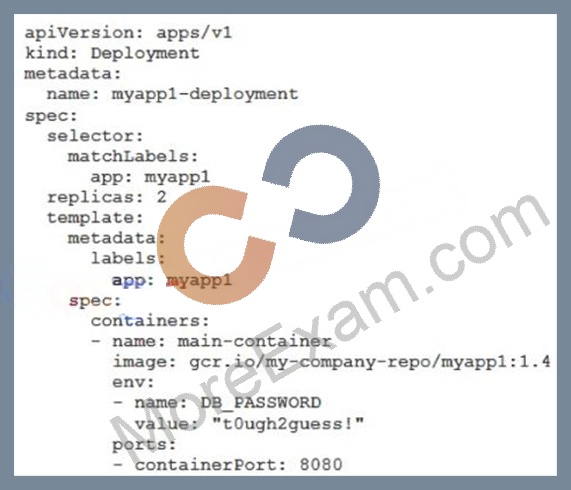
Question94: You've deployed a microservice called myapp1 to a Google Kubernetes Engine cluster using the YAML file specified below:You need to refactor this configuration so that the database password is not stored in plain text. You want to follow Google-recommended practices. What should you do?
Question95: You are creating a Google Kubernetes Engine (GKE) cluster with a cluster autoscaler feature enabled. You need to make sure that each node of the cluster will run a monitoring pod that sends container metrics to a third-party monitoring solution. What should you do?
Question96: Several employees at your company have been creating projects with Cloud Platform and paying for it with their personal credit cards, which the company reimburses. The company wants to centralize all these projects under a single, new billing account. What should you do?
Question97: Your company has multiple projects linked to a single billing account in Google Cloud. You need to visualize the costs with specific metrics that should be dynamically calculated based on company-specific criteri a. You want to automate the process. What should you do?
Question98: You have a development project with appropriate IAM roles defined. You are creating a production project and want to have the same IAM roles on the new project, using the fewest possible steps. What should you do?
Question99: Your application development team has created Docker images for an application that will be deployed on Google Cloud. Your team does not want to manage the infrastructure associated with this application. You need to ensure that the application can scale automatically as it gains popularity. What should you do?
Question100: Your team has developed a stateless application which requires it to be run directly on virtual machines. The application is expected to receive a fluctuating amount of traffic and needs to scale automatically. You need to deploy the application. What should you do?
Question101: You are analyzing Google Cloud Platform service costs from three separate projects. You want to use this information to create service cost estimates by service type, daily and monthly, for the next six months using standard query syntax. What should you do?
Question102: Your Dataproc cluster runs in a single Virtual Private Cloud (VPC) network in a single subnet with range 172.16.20.128/25. There are no private IP addresses available in the VPC network. You want to add new VMs to communicate with your cluster using the minimum number of steps. What should you do?
Question103: You are using Deployment Manager to create a Google Kubernetes Engine cluster. Using the same Deployment Manager deployment, you also want to create a DaemonSet in the kube-system namespace of the cluster. You want a solution that uses the fewest possible services. What should you do?
Question104: You are building a product on top of Google Kubernetes Engine (GKE). You have a single GKE cluster. For each of your customers, a Pod is running in that cluster, and your customers can run arbitrary code inside their Pod. You want to maximize the isolation between your customers' Pods. What should you do?
Question105: You want to run a single caching HTTP reverse proxy on GCP for a latency-sensitive website. This specific reverse proxy consumes almost no CPU. You want to have a 30-GB in-memory cache, and need an additional 2 GB of memory for the rest of the processes. You want to minimize cost. How should you run this reverse proxy?
Question106: A colleague handed over a Google Cloud project for you to maintain. As part of a security checkup, you want to review who has been granted the Project Owner role. What should you do?
Question107: You are building a backend service for an ecommerce platform that will persist transaction data from mobile and web clients. After the platform is launched, you expect a large volume of global transactions. Your business team wants to run SQL queries to analyze the dat a. You need to build a highly available and scalable data store for the platform. What should you do?
Question108: You need to reduce GCP service costs for a division of your company using the fewest possible steps. You need to turn off all configured services in an existing GCP project. What should you do?
Question109: You just installed the Google Cloud CLI on your new corporate laptop. You need to list the existing instances of your company on Google Cloud. What must you do before you run the gcloud compute instances list command?Choose 2 answers
Question110: You need to grant access for three users so that they can view and edit table data on a Cloud Spanner instance. What should you do?
Question111: You are working for a hospital that stores Its medical images in an on-premises data room. The hospital wants to use Cloud Storage for archival storage of these images. The hospital wants an automated process to upload any new medical images to Cloud Storage. You need to design and implement a solution. What should you do?
Question112: You are building a pipeline to process time-series data. Which Google Cloud Platform services should you put in boxes 1,2,3, and 4?
Question113: You need to manage a Cloud Spanner Instance for best query performance. Your instance in production runs in a single Google Cloud region. You need to improve performance in the shortest amount of time. You want to follow Google best practices for service configuration. What should you do?
Question114: You are asked to set up application performance monitoring on Google Cloud projects A, B, and C as a single pane of glass. You want to monitor CPU, memory, and disk. What should you do?